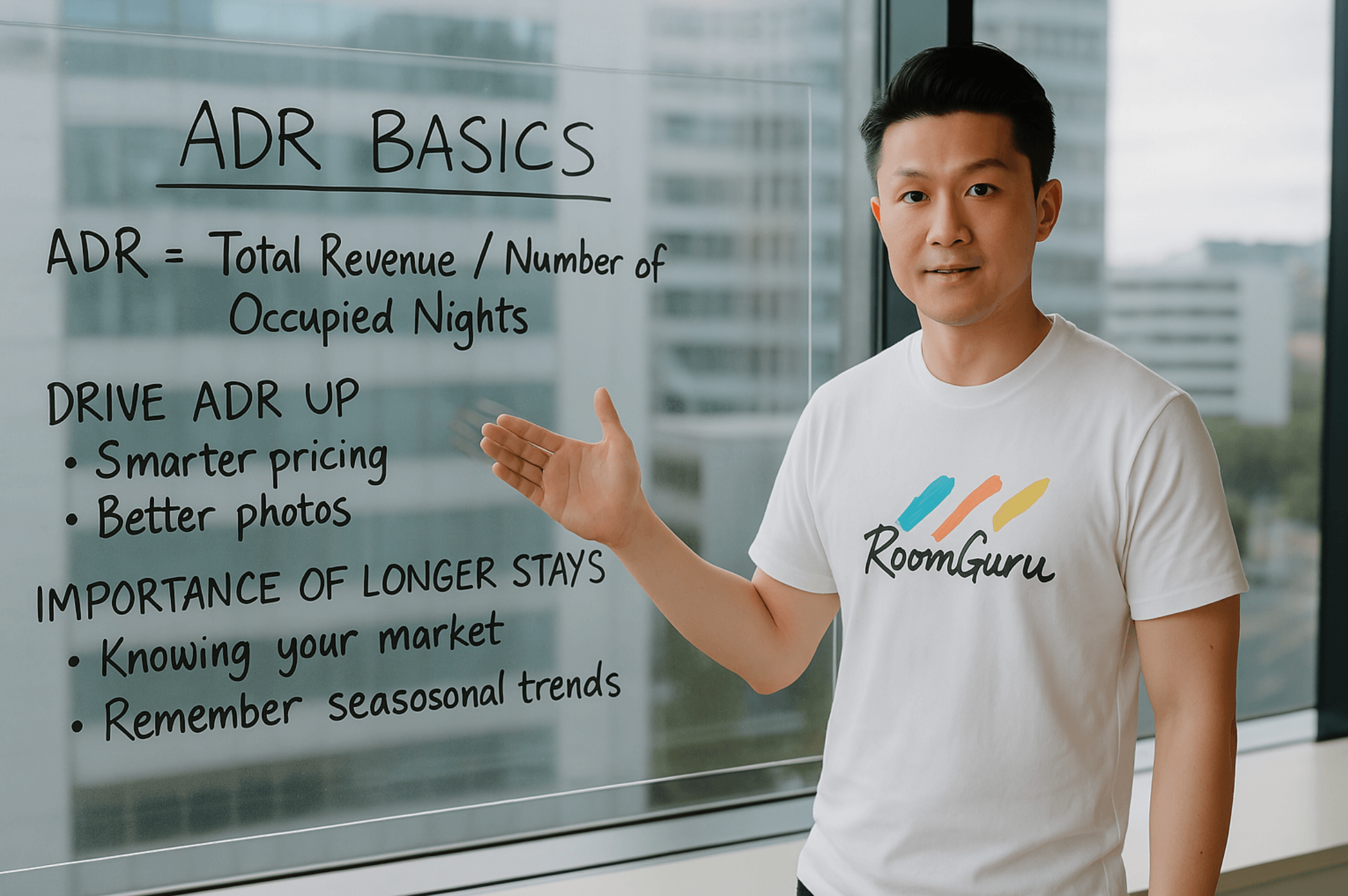
Another almost fully booked month… I remember staring proudly at the calendar, beer in hand, ready to celebrate… until I checked the total revenue 😞
Despite a 70%++ occupancy rate, the returns were disappointing. Bookings were coming in, but the numbers weren’t making sense. So, I called my friend Jessie, who had been in Airbnb management a few months longer than me.
The first thing she asked was, “What’s your property’s ADR?” I went completely silent as I had no clue what she was talking about 😅
That conversation changed everything. At RoomGuru, we realised we’d been chasing bookings when we should have been optimising value.
The ADR Wake-Up Call
ADR = Total Revenue / Number of Occupied Nights
ADR is simply the total rental revenue divided by number of occupied nights. A basic formula, yet it reveals the true health of your rental business.
A higher ADR means earning more per booked night, even with fewer bookings, leading to higher revenue with less operational effort. On the other hand, a lower ADR may fill up more nights but often results in more work, higher cleaning costs, and increased wear and tear, without necessarily increasing total earnings.
Take a look:
- Property A: 80% occupancy (24 nights) at RM200 = RM4,800 monthly revenue
- Property B: 60% occupancy (18 nights) at RM300 = RM5,400 monthly revenue
Property B earns RM600 more each month with 6 fewer turnovers. That means lower cleaning costs, less wear and tear, and fewer check-in/check-out hassles.
A simple shift in focus from occupancy to ADR makes all the difference.
How Your Neighborhood Shapes Pricing
Each JB neighborhood has its own ADR personality, shaped by guest demand and travel patterns.
In Danga Bay, our waterfront units go for RM250-320 on weekends as Singaporeans cross the border for a short escape. Come midweek, rates drop to RM180-250; it’s just how the market moves, and we’ve learned to go with the flow 🙂
At the same time, our properties near LEGOLAND follow a different rhythm. School holidays push rates up to RM280-670, but once the crowds leave, they settle at RM120-180. Learning to ride these ups and downs changed the way we price.
Recognising these patterns helps us price smarter, bringing in better revenue without just chasing high occupancy.
The Calendar Secrets
Our 2 years of data uncovered JB’s unique seasonal ADR patterns.
June and December bring the expected gold rush during Singapore school holidays, with family-friendly properties seeing rates soar 50-90% above baseline.
But the real surprise? Those hidden gems during long weekends around Vesak Day, National Day, and Deepavali, etc. These 2-4 day mini-peaks can push rates close to holiday levels, making them just as valuable for smart pricing strategies!
Beyond One-Night Stands
Chasing the highest nightly rate led us to an unexpected discovery that longer stays often bring better returns, even with a slightly lower ADR.
A five-night booking at RM280 per night consistently beats five separate one-night stays at RM320 when factoring in cleaning fees, check-ins, and operational costs.
During peak periods, setting a three-night minimum stay didn’t just cut down turnover workload but it actually boosted total revenue.
A Picture That Pays for Itself
In the beginning, we took all the listing photos ourselves, just some quick shots on the phone. The unit looked decent, but nothing special. Bookings came in, but the rates weren’t great.
After the company started making steady profits, we hired a professional photographer. With proper lighting, angles, and staging, the space instantly looked more premium. Within weeks, ADR jumped average of 7%, and we started attracting higher-paying guests.
Good photos don’t just make a place look better. They elevate its perceived value, allowing us to charge what it’s truly worth.
The Sweet Spot in Pricing
Managing properties across JB’s diverse neighbourhoods has taught us that ADR isn’t about squeezing the highest rate out of every night. It is about finding the right balance between pricing, occupancy, and operational efficiency.
The properties delivering the best returns aren’t always the ones with the highest ADR. They are the ones managed with a holistic approach, where pricing adapts to JB’s unique market rhythms.
That conversation with my friend changed everything. Now we don’t just measure success by how many nights are booked but by how much value we extract from each stay. In JB’s dynamic market, understanding ADR isn’t just about numbers. It is about unlocking your property’s true potential.