← Straight Answers Part of: Airbnb numbers explained
Owner terms · 2 min read
What is ADR? Start with 1 night, and you'll get it in 2 minutes
ADR (average daily rate) is the average money each booked night brings in: money made ÷ nights booked. Empty nights don't count. It answers 1 question: when a night gets booked, how much does it bring in, on average?

In short
- ADR = money made ÷ nights booked. Empty nights don't count.
- ADR tells you the price. Occupancy tells you how full. You need both.
- A higher ADR can make less money if it leaves more nights empty.
- The same booking can show different ADRs, depending on what money is counted. Every statement is made its own way.
In this article
ADR sounds like hotel talk. It's really 1 simple question: when a night gets booked, how much money does it bring in, on average?
Let's build it from 1 night.
| Term | What it tells you | The sum | Example |
|---|---|---|---|
| ADRaverage daily rate | The average money each booked night made | Money made ÷ nights booked | RM4,800 ÷ 24 = RM200 |
| Occupancyhow full it was | How many nights were booked | Nights booked ÷ nights open | 24 ÷ 30 = 80% |
| RevPARrevenue per available night | The month's money spread over every night open | Money made ÷ nights open, or ADR × occupancy | RM4,800 ÷ 30 = RM160 |
1 made-up unit, open all 30 nights of a month: 24 nights booked, RM4,800 made.
 Play the video: How to Calculate Airbnb ADR: Average Daily Rate Explained in Under 3 Minutes, 2:50
Start with 1 night. Then try a whole week
1 night booked at RM200 brings in RM200. Easy.
Now a week, where weekends cost more and some nights sit empty. What does a booked night bring in now?
Book your own week
Each box is 1 night, with its price in RM. Tap a night to book it or leave it empty.
RM880 made from 4 booked nights. ADR is RM220.
Now tap Monday, and watch the sum.
That number is ADR:
ADR equals money made divided by nights booked
Why empty nights don't count
Think of a nasi lemak stall
In the morning the stall wraps 14 packets. By noon it sells 10, at RM3 each. 4 are left, and tomorrow they can't be sold.
Right. Each packet sold brought in RM3.
ADR works the same way. A night nobody booked is a packet nobody bought: it brought in RM0, so it stays out of the sum.
So ADR answers "how much per booked night?" How full the calendar was is a different question, called occupancy: nights booked ÷ nights open.
Try your own month:
Work out your own ADR
Type in 1 month from your statement. The answers change as you type.
- ADR
- RM200
- RM4,80024 nights booked
- Occupancy
- 80%
- 24 nights booked30 nights open
- RevPAR
- RM160
- RM4,80030 nights open
ADR vs RevPAR: can a higher price make less money?
Guess first:
Quick guess
Unit B charges more a night. Which unit fills its month with more money?
24 nights × RM200 = RM4,800
15 nights × RM260 = RM3,900
Unit A makes more. Its price is lower, but 9 more nights were booked.
RevPAR spreads each month's money over all 30 nights, booked or empty. One number for price and empty nights together.
A higher ADR can make less money if it leaves more nights empty. So look at ADR and occupancy together. Or use RevPAR, 1 number that shows both:
RevPAR equals money made divided by nights open equals ADR times occupancy
Unit A: RM200 × 80% = RM160. Unit B: RM260 × 50% = RM130.
It can go the other way too: a higher price with fewer nights can make more. RevPAR counts money in, not costs, so check cleaning costs as well.
Thinking of a discount to fill more nights? See is Airbnb's 15% top-rated guest discount worth it?
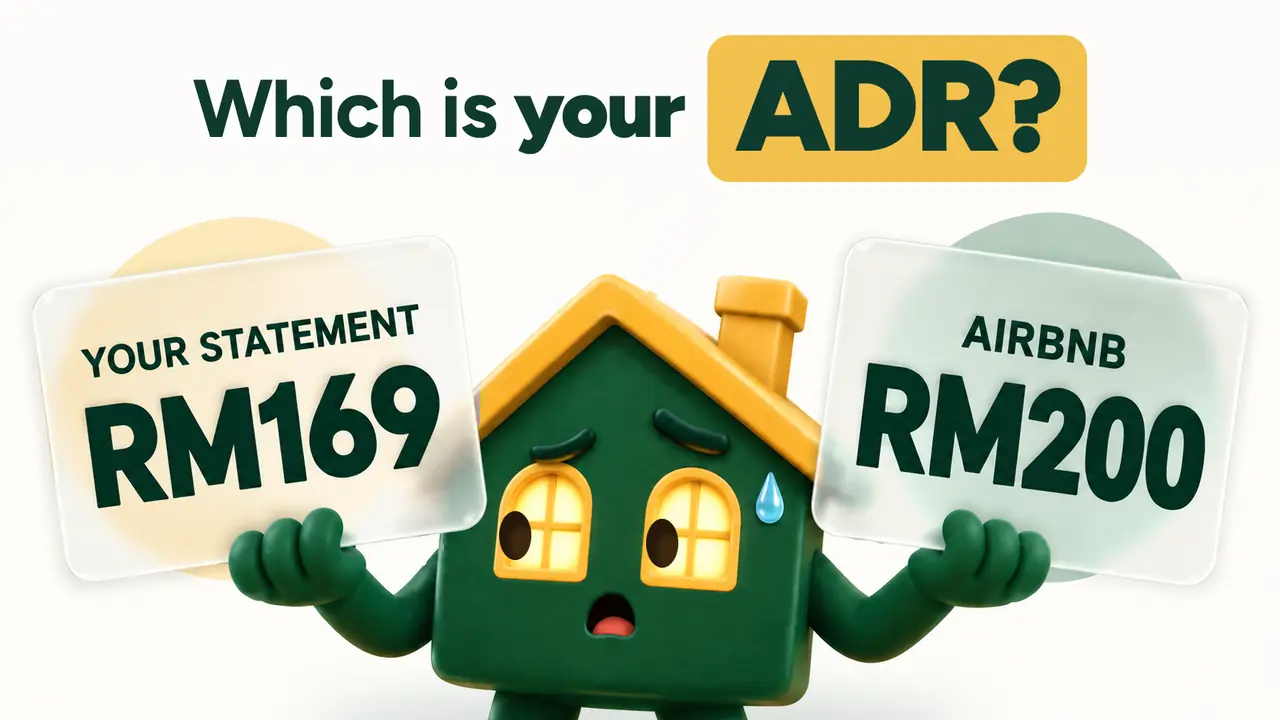
Same booking, 3 ADRs: why statements disagree
Here's the twist. "Money made" can mean different money.
One booking, 3 ADRs
1 booking, 3 nights. Here is all the money in it:
- RM600room, 3 × RM200
- RM90cleaning fee
- RM93Airbnb's fee on the room
| Way of counting | The sum | ADR |
|---|---|---|
| Room price onlyHotels | RM6003 nights | ADRRM200 |
| Plus the cleaning feeAirbnb's dashboard, AirDNA | RM600+RM903 nights | ADRRM230 |
| After Airbnb's feeRoomGuru statements | RM600−RM933 nights | ADRRM169 |
None of the 3 is wrong. Each one counts different money.
Every manager makes their statement their own way, so only compare ADRs counted the same way. Airbnb's own dashboard is closest to the RM230 way: its "average nightly revenue" includes the fees you charge and is counted before Airbnb's fee.
On our statements, ADR is the line "Avg. nightly rate". It's counted after Airbnb's fee and before the management fee. How your fee is worked out is set by your own contract, not by this article.
Next statement: 3 checks so you stop worrying
Your next statement: 3 checks
0 of 3 checked
For the rest of the statement, read how to read your manager's monthly statement.
It's number 1 of our 3 Airbnb numbers every owner should know.
Questions owners ask
What does ADR mean on Airbnb?
ADR means average daily rate: the average money each booked night brings in. Airbnb's own dashboard doesn't say ADR. It shows "average nightly revenue", which includes fees you charge, like cleaning, and is counted before Airbnb's fee.
How do you calculate ADR?
Divide the money your bookings made by the number of nights booked. 24 booked nights that made RM4,800 give an ADR of RM200. Empty nights are left out.
Why does my statement show a different ADR from my Airbnb price?
Your Airbnb price is what the guest sees for 1 night. Your statement may add the cleaning fee in, or take Airbnb's fee out. Every manager makes their statement their own way, so ask what yours counts.
Does ADR include the cleaning fee?
It depends who counts it: hotels count the room price only. Airbnb's "average nightly revenue" and AirDNA, a rental data site, include it. Some statements, ours included, leave it out and take Airbnb's fee off too.
What is the difference between ADR and RevPAR?
ADR is money made ÷ nights booked. RevPAR is money made ÷ every night the home could be booked. RevPAR equals ADR × occupancy, so it shows the price and the empty nights in 1 number.
Sources: Hotel ADR is room revenue ÷ rooms sold, with only room revenue counted: Hotel Online, following the hotel industry's accounting rules (USALI). AirDNA's ADR "include[s] the cleaning fee set by the host but do[es] not include Airbnb service fees": AirDNA Help Centre. Airbnb's "average nightly revenue" is "the average amount of money you've received from a booking, including fees you charge, before our service fee, taxes, or any other fees are deducted", and its occupancy rate is "your nights booked at your listings divided by the total available nights": Airbnb Help Centre. Airbnb's host fee: most hosts on the split fee pay 3%; the single fee is a must for hosts who use property management software, and most of them pay 15.5%; host fees are "a percentage of the nightly price and any fees charged by the host": Airbnb Help Centre. Airbnb's fee can differ by host and country. How RoomGuru counts ADR: our own statement. The prices, bookings and units in this article are made-up examples. This is general information, not financial advice.